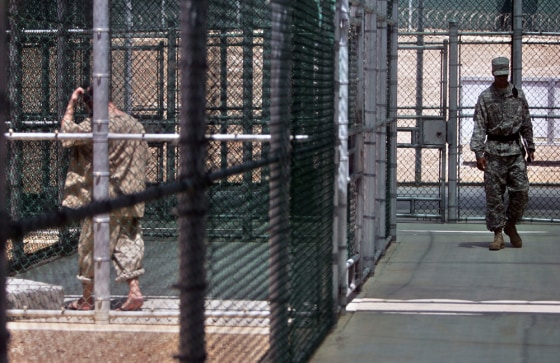
Lawyers representing many of the 265 detainees at Guantanamo Bay say they are heading for a unexpected logjam that could delay federal court hearings: a shortage of interpreters.
After the Supreme Court ruled that terrorism suspects held at the military prison in Cuba have a right to seek their release in federal court, lawyers are gearing up for what they expect to be an avalanche of legal briefs and new evidence filed by the Justice Department. Lawyers say they are trying to rush to meet with their clients in advance of cases that judges may want to hear quickly.
"The shortage of interpreters will pose a problem, because it's already difficult enough to get to Guantanamo and to see one's client," said Martha Rayner, a lawyer who represents two detainees and is also a clinical associate professor of law at Fordham University Law School in New York. "But without an interpreter, the meeting can't take place."
The issue concerns lawyers so much that they clashed with the Justice Department recently when the security clearances for several Arabic interpreters were rescinded for unexplained reasons. Worried the pool would grow even smaller, the lawyers said they enlisted the help of U.S. District Judge Royce C. Lamberth, who prodded Justice officials into fixing the clearance problems
Just over a dozen interpreters, who speak languages ranging from Arabic to Russian and work for more than 400 lawyers, have performed critical work in recent years, acting as interpreters of not only language but also culture. The prisoners' attorneys say they have played a vital role in helping them build trust with often-suspicious detainees.
The lawyers hire the interpreters, who must be U.S. citizens and pass a rigorous background check. The government and military contractors have already snapped up many interpreters, further reducing the pool of available talent for the detainees' lawyers, according to outside experts.
The interpreters can charge as much as $1,400 a day, a rate that is three times what they would charge for similar work in the United States, interpreters and lawyers said. Several interpreters said they are already booked through mid-November.
In response to the shortage, the lawyers said they are asking the government to increase the hours and days they may talk to their clients at Guantanamo to maximize use of their interpreters. Currently, lawyers may only visit their clients on work days for two three-hour stints each day.
Some lawyers are pushing the military to allow telephone and video conferences with the detainees, a move that attorneys say would probably reduce the security clearance requirements for interpreters working with lawyers on the U.S. end of calls because they would not have to visit the secure military base.
"If we got them to change the rules, the number of hours, and we worked New York lawyers' hours instead of a European auto plant workers' schedule, there would be less of a problem," said Shayana Kadidal, a lawyer with the Center for Constitutional Rights, which has spearheaded the detainees' legal efforts.
The Defense Department, however, has no plans to change the hours or security requirements, said Navy Cmdr. Jeffrey D. Gordon, a spokesman for the department. Gordon said the government is working as quickly as possible to clear interpreters to work at Guantanamo and that restrictions on who may speak to detainees "are necessary to protect national security."
When lawyers first were allowed to visit the detainees in 2004, they searched frantically for months to find interpreters -- in languages including Pashto, Farsi, Arabic and Uighur, spoken by a group of detainees from western China.
Through referrals from trade groups, cultural organizations, universities and other lawyers, the attorneys cobbled together a small pool that is largely unchanged since they first started visiting the prison. The interpreters, who live across the United States, travel back and forth to Guantanamo and get paid for travel days. Soon, the lawyers said they were afraid to try new interpreters outside the small pool because the stakes of the initial visits are so high.
About 210 of the 265 prisoners -- from more than 30 countries -- at Guantanamo are represented by lawyers who are challenging their detentions before federal judges in U.S. District Court. The others have not filed lawsuits seeking to challenge their detentions.
During meetings, the interpreters said they improvise far more frequently than when they are working in courtrooms or for business meetings in the United States. And they also admitted to fudging what the lawyers are saying so they don't offend the detainees' sensibilities.
"Perhaps at Guantanamo, like no where else, the interpreter has to change the nuance of what is being said," said an Arabic interpreter, who requested that his name not be used because lawyers did not authorize him to be interviewed. "Culture, Islamic culture, is very important at Guantanamo. Sometimes the lawyer will make a politically incorrect statement. You raise your eyebrows, try to get their attention or get them to rephrase. . . . Or you leave things out and tell the lawyer later what he should not have been saying."
Mahvish Rukhsana Khan, 29, of San Diego, became an interpreter after visiting Guantanamo as a law student helping detainees' attorneys. A fluent Pashto speaker, Khan visited Guantanamo every other week for a year before lawyers found others who could speak the language. The "list of interpreters is very limited," she said.
At Guantanamo, Khan said much of her time has been spent navigating the cultural divides and "being a buffer" between the volunteer lawyers, many from corporate law firms, and the detainees. Lawyers sometimes asked the detainees about their wives and daughters, a route of conversation that would make the prisoners uncomfortable, she said.
"It is good information to collect for an affidavit, but they are very private about women in their families," said Khan, who wrote a memoir published this year about her experiences as an interpreter, "My Guantanamo Diary: The Detainees and the Stories They Told Me."
Eventually, Khan said she became close friends with the detainees and brought them food and showed them videotapes of their families that were made in Afghanistan. "They trusted me, and I helped bridge the gap," she said.
Julia Karpeisky, a Russian interpreter who lives in McLean, works with three inmates at Guantanamo. She said a major part of her job involves ensuring that lawyers are communicating in terms that the detainee can understand. Most have limited educations and are not familiar with the U.S. legal system, she said.
In one instance, a lawyer began to describe a recent victory at the U.S. Supreme Court, and the interpreter had to intervene to get him to explain things more simply. "These are corporate attorneys who are used to very bright clients," Karpeisky said. "I told them to start with how the court system works in very simple terms."
Staff writer Josh White and staff researcher Julie Tate contributed to this report.