Reflective dishes may be the answer to make solar energy competitive with conventional sources of power, Israeli scientists say.
A global race is on to find energy alternatives as subsidies tip the balance in favor of renewable sources of power, which answer security and climate change concerns about fossil fuels.
New-found demand for one such renewable source, solar energy, has hoovered up supply of the silicon raw material, prompting a search for alternatives.
A team at Israel’s Ben Gurion University believe they have found just that, in a far less known material that is more expensive than silicon but also more efficient when used with a reflective dish.
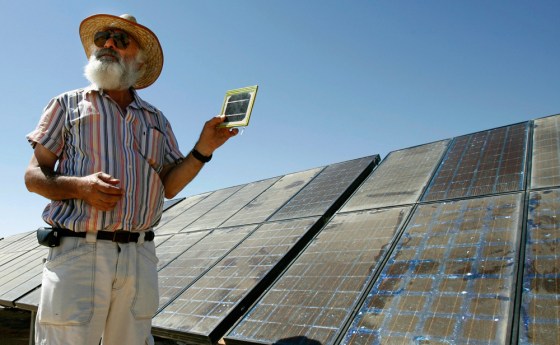
“The dish could be put in a sunny backyard and generate most of the home’s utility needs,” said David Faiman, a professor of physics at Ben Gurion University who has studied solar energy for 31 years in Israel’s Negev desert.
“The costs per watt are comparable to that of a conventional power plant, but without fuel,” Faiman added.
In a research note earlier this year, analysts at Jefferies investment bank said that the alternative to silicon — called gallium arsenide — was still too expensive and at a very early stage, but that coupling its use with mirrors could cut costs.
Mirrors intensify the light
Faiman’s team have designed a reflector made of mirrors that collects and intensifies the light a thousand times over. This concentrated light, which Faiman says is strong enough to burn organic material, is directed at the solar panel.
Silicon solar panels both collect and convert sunlight into electricity. The panels Faiman and his team use can handle the intensified light and convert it into energy with twice the efficiency of ordinary panels, they say.
Faiman said he is collaborating with an Israeli start-up company, Zenith Solar, to create a home solar energy system that uses a 107-square-foot reflector dish.
The technology could also be applied at scale, he said. A solar energy system built on 4.6 square miles in the Negev would produce 1,000 megawatts of electricity, or approximately 10 percent of Israel’s general electricity needs, Faiman said.
U.S. expert voices caution
George Crabtree, director of the materials science division at the U.S. Department of Energy’s Argonne National Library, sounded a note of caution, however.
While Faiman’s work is a “promising approach” to large scale solar energy, the technology has yet to be proven in areas like system integration and total cost competitiveness, he said.
“It is likely to take several more years before the other aspects of CSP (concentrated solar power) technology are sufficiently developed and proven ready for deployment. CSP technology is like digital audio ten years ago,” Crabtree said.
Solar power derived from conventional silicon could compete, without subsidies, in five years time in very sunny places such as Italy and parts of the United States, analysts say.
Faiman would not discuss details of the Zenith Solar deal but said a prototype already existed and could be ready by the end of 2008. Zenith Solar would not comment on the project.
Israel is eager to find alternative energy sources and is researching the costs of Faiman’s solar energy systems for the home.
“(Israel’s) ministry of infrastructure knows of Professor Faiman’s system. It is the ministry’s goal to integrate renewable energy in the most fitting way into the Israeli market,” the ministry said in a statement.