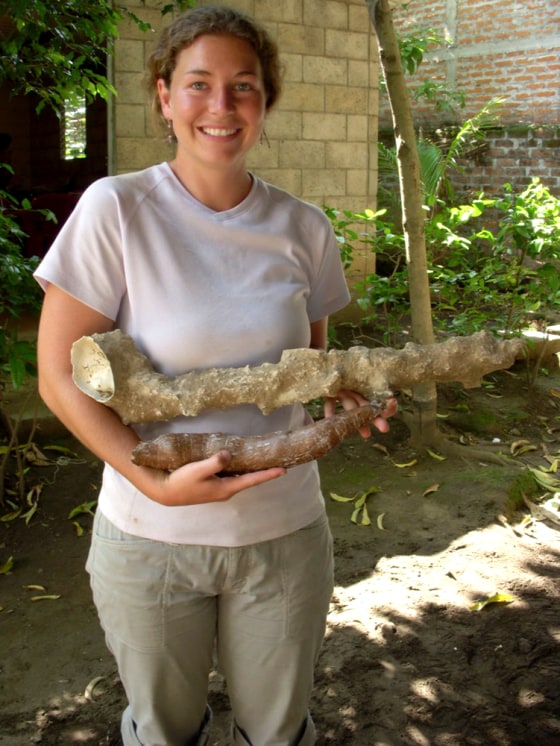
A volcanic eruption that buried a Mayan village 1,400 years ago preserved a manioc field—the first evidence that the nutritious crop was cultivated by the ancient people, researchers said on Monday.
The discovery may help explain how the civilization prospered, the team at the University of Colorado at Boulder said. It is the first evidence for cultivation of the calorie-rich tuber in the New World.
“We have long wondered what else the prehistoric Mayan people were growing and eating besides corn and beans, so finding this field was a jackpot of sorts for us,” anthropologist Payson Sheets, who led the expedition, said in a statement.
“Manioc’s extraordinary productivity may help explain how the Classic Maya at huge sites like Tikal in Guatemala and Copan in Honduras supported such dense populations.”
The manioc field lay under 10 feet of ash at the ancient village of Ceren, 15 miles west of San Salvador, Sheets said.
Like Italy’s Pompeii, Ceren’s buildings, artifacts and landscape were preserved by the sudden eruption of a volcano—in this case the nearby Loma Caldera volcano about 600 A.D.
“What we essentially found was a freshly planted manioc field that was 1,400 years old,” Sheets said.
The team, which uses ground-penetrating radar to help direct excavations, has found 12 buildings at Ceren, including homes, storehouses, workshops, kitchens, religious buildings and a community sauna.
Several dozen other structures located with ground-penetrating radar remain buried under up to 17 feet of ash, said Sheets.
The Mayan civilization thrived in what is now Guatemala, Honduras, El Salvador, southern Mexico and Belize until it disappeared mysteriously around 1000 AD.