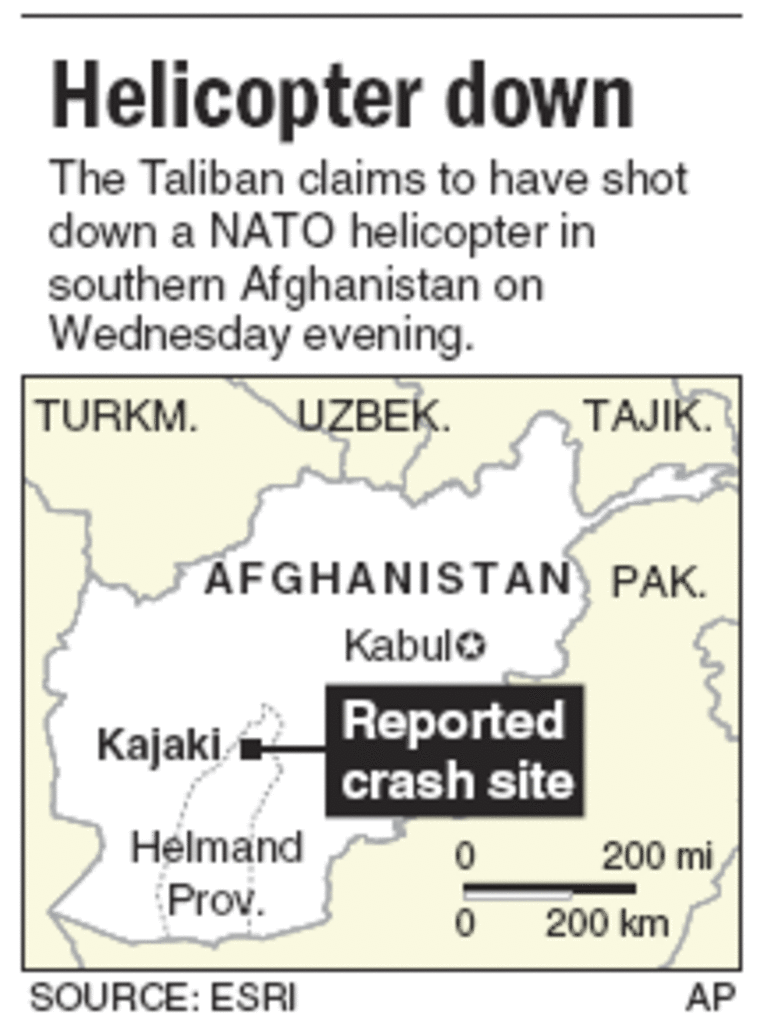
NATO troops on Thursday secured the wreckage of a CH-47 Chinook helicopter apparently shot down by Taliban militants, an attack that killed everyone on board — five U.S. soldiers, a Canadian and a Briton, officials said.
NATO said troops going to the crash site in southern Helmand province were ambushed by enemy fighters, and the unit called in an airstrike “to eliminate the enemy threat.” It did not say if the troops were from the U.S.-led coalition, NATO’s force or the Afghan army. One civilian was injured by gunfire.
Maj. John Thomas, a spokesman for NATO’s International Security Assistance Force, said there would be a full investigation into Wednesday’s crash. “We will try to determine everything that happened and to fully investigate the site,” he said.
A U.S. military official, who insisted on speaking anonymously because the crash was still under investigation, said initial reports suggested the helicopter was hit with a rocket-propelled grenade.
Incident in opium-growing region
A purported Taliban spokesman, Qari Yousef Ahmadi, claimed in a phone call to The Associated Press that militants shot the helicopter down in the province, the world’s largest opium poppy-growing region where combat has been heavy in recent months.
Ahmadi did not offer any proof for his claim, but he specified the helicopter crashed in the Kajaki district hours before NATO reported that information.
NATO said the CH-47 Chinook was carrying a crew of five and two military passengers when it crashed. The cause was “being determined by military officials,” it said.
The Chinook, a heavy transport helicopter with twin rotors, can carry up to around 40 troops plus a small crew. The fact it was flying at night suggests the helicopter may have been carrying troops on a nighttime air assault.
Defending hydroelectric dam
Kajaki is the site of a large U.S.-funded hydroelectric dam now being repaired so it can provide electricity to the southern city of Kandahar. British troops, who make up the bulk of the forces in Helmand province, have been engaged in fierce fighting around the dam to protect it.
The NATO force, which is responsible for a countrywide counterinsurgency campaign, has 37,000 soldiers, including about 14,000 Americans. There are 12,000 U.S. troops in the separate U.S.-led coalition, which trains the Afghan army and conducts Special Forces anti-terrorism operations.
Helicopter crashes in Afghanistan have been relatively rare. A Chinook crashed in February in the southern province of Zabul, killing eight U.S. service members. Officials ruled out enemy fire as the cause.
In May 2006, another Chinook crashed attempting a nighttime landing on a small mountaintop in eastern Kunar province, killing 10 U.S. soldiers.
U.S. military claims progress
Elsewhere, a senior military officer said U.S. forces have "got the Taliban on their heels" in Afghanistan.
Brig. Gen. Perry Wiggins, deputy director of operations for the Joint Chiefs of Staff, told Pentagon reporters that "as a result of a number of operations ... basically the Taliban has suffered numerous losses and has suffered losses to their senior leadership over this past month" in southern and eastern Afghanistan. As a result, he said, the Taliban has "reverted to asymmetric-type, small-scale, high-profile attacks."
Mullah Dadullah, a one-legged veteran who orchestrated an intensifying campaign of suicide attacks and beheadings, was killed in an operation in southern Afghanistan this month. He had been considered the top Taliban field commander.
Still, Wiggins noted that as the poppy harvest ends, more insurgents may join the battle.
"So the fight's not over," he said. "but we'll continue to take the offensive through several of the operations we have in Afghanistan, and hopefully ... continue to inflict casualties on the Taliban."