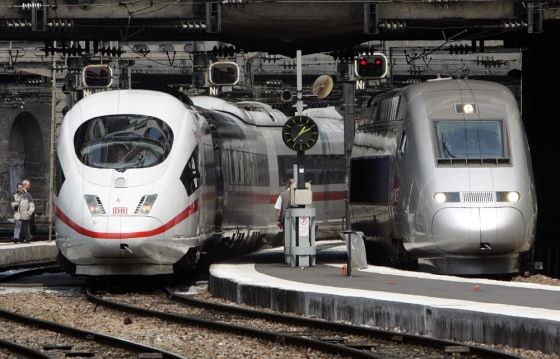
Two high-speed trains designed to cut travel time between Frankfurt and Paris almost in half made their first journey on Friday — and ran 35 minutes late.
The French-German run was billed as the beginning of Europe-wide high-speed rail network from Barcelona to Budapest, a dream that has been taking shape in Europe for years.
For now, the new fast train routes will reach four countries. France’s newest high-speed line, the TGV East, opens June 10 with service to cities in Germany, Luxembourg and Switzerland.
Ultimately, plans are to create two high-speed axes that meet in Strasbourg: one running between Paris, Munich, Vienna and Budapest; the other linking Hamburg, Frankfurt, Lyon and Barcelona.
When all is running smoothly, the new route will cut travel from Frankfurt to Paris to 3½ hours from 6 hours, 15 minutes today. It will run at speeds of up to 199 mph.
The line between Frankfurt and Strasbourg is the same one on which a TGV broke the world rail speed record last month, reaching 357.2 mph.
Friday’s journeys were primarily symbolic, marking an industrial milestone and a step in Europe’s integration. The joint venture, known as Alleo, is also being touted as an environmentally friendly option to fuel-guzzling airplanes.
Many European countries have their own high-speed trains, but developed their networks independently. Only limited international links exist. Technical differences between the trains have made cross-border links difficult.
The German train left Frankfurt and the French train left from Stuttgart, and then slowed to a crawl as they entered Paris’ Gare de l’Est station side-by-side.
The two trains arrived 35 minutes behind schedule — an embarrassment for the project partners France’s SNCF and Deutsche Bahn AG of Germany. Nervous SNCF officials did not immediately give a reason for the delay.
SNCF chief Anne-Marie Idrac kissed the cheeks of Deutsche Bahn counterpart Hartmut Mehdorn when he got off the German train. Curious travelers gathered nearby, snapping photos with their cell phones.
Mehdorn said a contract would eventually be signed by nine European railways. The deal would cement a common service level and allow for crossbookings, much as airlines offer.
The railway operators say the trains will be a cheaper, cleaner, and more hassle-free alternative to flying. Many travelers have grown frustrated with tougher airline security in Europe.
A typical second-class ticket on the train service will cost $133 between Frankfurt and Paris and $127 between Paris and Stuttgart. A standard Air France economy class ticket from Paris to Frankfurt costs about $268 round trip, or $669 one-way.
“The TGV is very efficient,” said Pierre-Louis Rochet, a former SNCF official. He said a traveler on a TGV train produces four to five times less carbon emissions than one on a plane.