Editorial Standards

Latest News Today maintains rigorous editorial standards. Our team verifies information from trusted sources and provides context to help readers understand complex stories.

Last Updated: Sunday, May 17, 2026 at 04:10 PM
Category: Id

Editor's Note

Latest News Today provides comprehensive coverage and analysis of breaking news stories. This article is part of our ongoing coverage of wbna17875610, bringing you verified information from trusted sources with added context and expert perspective.

Why This Matters: Understanding the full context of this story helps readers make informed decisions and stay updated on developments that impact our community.

Mile-wide asteroid passing by Earth

An asteroid is flying past Earth on Friday night at a minimum distance of about 2 million miles. That's about nine times farther away than the moon.
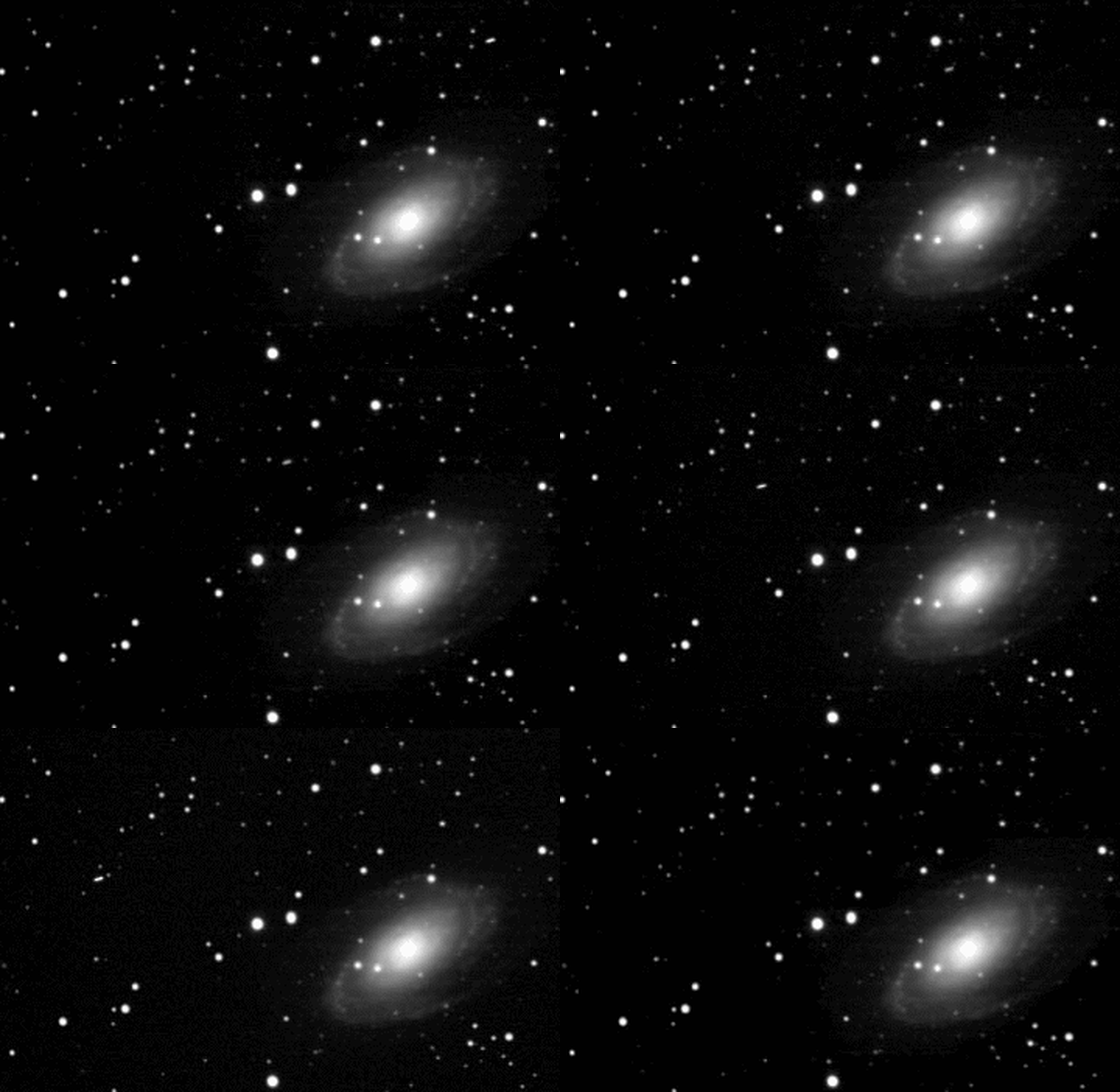
Image: Asteroid movie
In this 260-kilobyte animated image, the asteroid 2006 VV2 passes through a star field. The sequence of images was captured by astrophotographer Robert Long of the Astronomical Society of Las Cruces in New Mexico, using a CCD camera mounted on a 3-inch Orion ED80 refracting telescope. The image was reprocessed by SpaceWeather.com and may require extra time for downloading, due to the file size.Robert Long / via SpaceWeather.com

An asteroid is flying past Earth on Friday night at a minimum distance of about 2 million miles. That's about nine times farther away than the moon.

There is no danger of collision. And that's a really good thing. This space rock, named 2006 VV2, is more than a mile wide (about 2 kilometers), according to the Web site SpaceWeather.com. If one that big did hit Earth, it would destroy everything for hundreds of miles around and likely upset global commerce and create climate change unlike anything seen in modern history.

The rock will be far too dim to see with the naked eye. Seasoned backyard astronomers will try to spot it with good-sized telescopes and CCD cameras, however.

The best viewing locations will be in the Americas, according to SpaceWeather.com. The rock will pass directly over Southern California at about 11 p.m. PT.

Astronomers have cataloged hundreds of asteroids larger than a half-mile that sometimes pass in the vicinity of Earth's orbit. None are known to be on a collision course, but more remain to be found. One asteroid, called Apophis, will pass very close to Earth in the year 2029 and has a minor chance of hitting the planet in 2036. Some have called for a mission to track Apophis more closely by attaching a device to it.