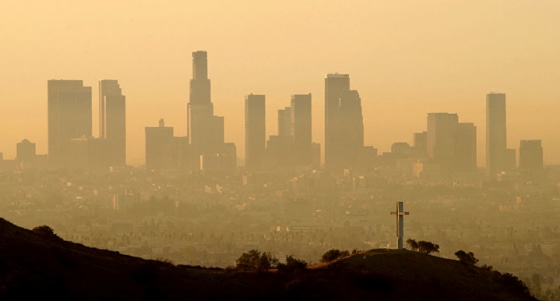
Clean air activists and utilities had different reactions to new rules directing 20 U.S. states to slash levels of tiny particles spewed by power plants, cars and other sources by 2010.
About 88 million people in more than 200 counties — mostly clustered around big cities like Los Angeles and New York — live where "particulate" levels exceed legal limits set by the Environmental Protection Agency.
The offending particles — 30 times smaller than the width of a human hair — are linked to premature death from heart and lung disease, as well as chronic bronchitis and asthma.
Governors of affected states must give EPA their cleanup plans by February 2008, and designated areas must lower particulate pollution to what the agency considers to be a safe level by 2010, according to the rules released Thursday.
Clean air advocates called the rules "a dirty power industry protection plan," and said they may actually hamper states' ability to clean up air pollution.
That's because plants could comply with requirements by purchasing emission credits established by a nationwide "cap-and-trade" program proposed by the White House.
"This is a flagrant gift to the electric power industry," said Frank O'Donnell of Clean Air Watch, an advocacy group.
Such comments "take the rule out of context," said Steve Lomax, manager of air quality programs at the Edison Electric Institute, which lobbies for most big U.S. utilities, including American Electric Power, Southern Co. and Duke Energy Corp.
Utilities will spend $50 billion to install technology to comply with new clean-air standards set by the Bush administration, which require them to cut emissions of sulfur dioxide and nitrogen oxides by 70 percent, Lomax said.
The Clean Air Act already allows states to require additional cuts, if they wish, an EPA spokesman said.
Most states that violate federal clean air rules are clustered around the Midwest, which has the most coal-fired generation, and in Northeast states between Washington, D.C., and New York, the EPA said.
Other counties with unhealthy levels are in Southern California and near Atlanta, Georgia, it said.
Counties with the most severe problems — like those around Los Angeles — could get a five-year extension, delaying attainment until 2015, the EPA said.