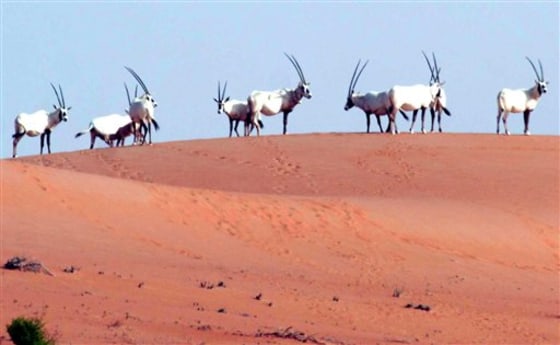
Ninety-eight Arabian oryxes have been released into the desert of the United Arab Emirates in an attempt to reintroduce the creature to its natural habitat after 40 years of extinction in the Persian Gulf country.
The plan involves releasing around 100 captive-bred oryxes into remote desert areas in the oil-rich emirate of Abu Dhabi every year until 2012, a total of around 500 animals. The Arabian oryx is a large and graceful white antelope with antennae-like horns that was officially declared extinct from the wild in 1972.
"Our terrestrial environment research center has been releasing these oryxes in hopes to create a self-sustaining population that roams freely in our deserts," Majid al-Mansouri, secretary general of Abu Dhabi's environment agency, said in a press release Sunday.
The agency is in the process of having the nearly 4,000 square-mile habitat classified as a protected area. Desert rangers will patrol the area, the press release said.
Shelters and feeding centers are helping oryxes adapt to their new environment. These will gradually be removed as the animal learns to survive independently.
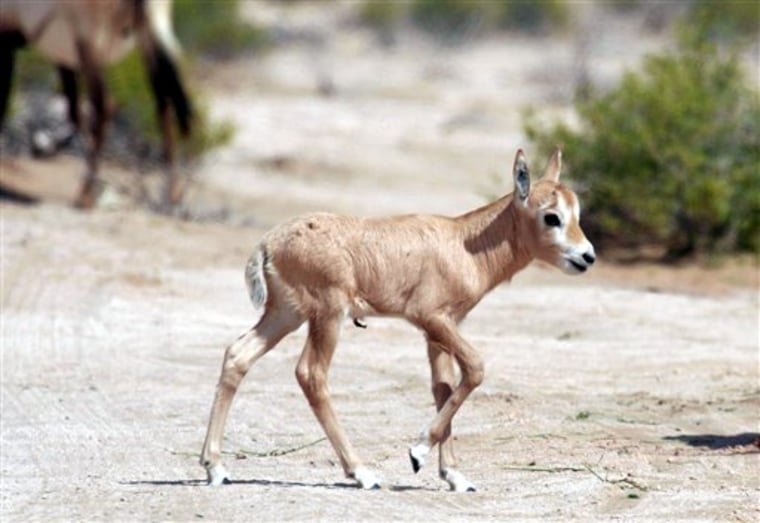
Of the five species of oryx in the wild, the Arabian oryx is the only one that inhabited the Middle East. The other four species are found in Africa. The Arabian oryx's traditional range once extended into the northern part of the Arabian Peninsula and Iraq, Syria, Jordan and Israel.
The federal government arranged a program of captive breeding just before hunting and habitat destruction caused the disappearance of the animal from the peninsula.
Today, there are approximately 4,000 of these animals living in captivity in the Emirates, and another 2,000 in other parts of the Middle East, the press release said.
Other similar reintroduction projects have taken place in neighboring Oman and Saudi Arabia.
The Arabian oryx has long thin horns that can reach three feet and it can live for up to 19 years. It lives on grasses and shrubs, and finds sufficient water for its needs from the morning dew gathered on desert plants.