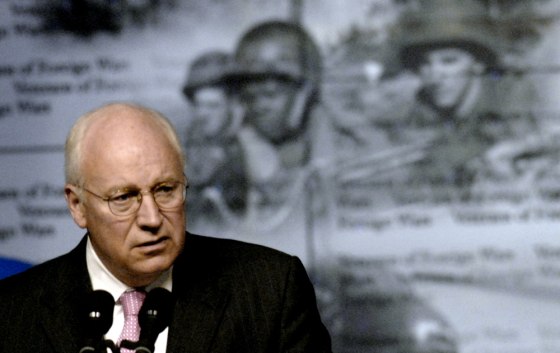
Vice President Dick Cheney Monday seized on Democratic calls to pull troops out of Iraq to draw an election-year link between early withdrawal and the possibility of terrorist attacks in the United States.
As Cheney and President Bush try to help Republicans keep control of Congress on Nov. 7, polls show public support for the war ebbing away. But Bush gets better marks for his handling of terrorism and Cheney tied the two together.
"Some in our own country claim retreat from Iraq would satisfy the appetite of the terrorists and get them to leave us alone," Cheney told a Veterans of Foreign Wars convention in Reno, Nevada. "A precipitous withdrawal from Iraq would be ... a ruinous blow to the future security of the United States."
'Hornet's nest' rejected
Cheney did not use the word "Democrats," choosing instead the anonymous "some," but he rejected the argument many have made that by invading Iraq in March 2003, the United States simply "stirred up a hornets' nest."
"They overlook a fundamental fact. We were not in Iraq on Sept. 11, 2001, but the terrorists hit us anyway," he said, in a reference to the hijacked plane attacks that killed almost 3,000 people.
Iraq-terror connection
When Bush answered a question about Iraq last week by raising Sept. 11, a reporter asked him "What did Iraq have to do with that?" The president replied, "Nothing," and added, "Nobody has ever suggested in this administration that Saddam Hussein ordered the attack."
But prior to the U.S.-led invasion, Cheney suggested that one of the Sept. 11 hijackers met in Prague before the attacks with an Iraqi intelligence agent. The bipartisan Sept. 11 Commission found no evidence such a meeting took place.
Sept. 11 and its aftermath, as well as the build-up and early successes in the Iraq war, were winning issues for Republicans in 2002 and 2004. With the unpopular war now helping to drag Bush's poll numbers down to the lowest of his presidency, the White House has sought to cast it as part of the broader struggle against terror.
Terrorist ambitions
Cheney said terrorists wanted to arm themselves with chemical, biological and even nuclear weapons, "to destroy Israel, to intimidate all Western countries and to cause mass death in the United States."
He suggested critics were naive and did not understand the magnitude of the threats.
"Some might look at these ambitions and wave them off as extreme and mad," he said. "Well, these ambitions are extreme and they are mad. They are also real and we must not wave them off, we must take them seriously."
Cheney said he welcomed the vigorous debate over Iraq but added: "There is a difference between healthy debate and self-defeating pessimism. "We have only two options on Iraq - victory or defeat - and this nation will not pursue a policy of retreat."