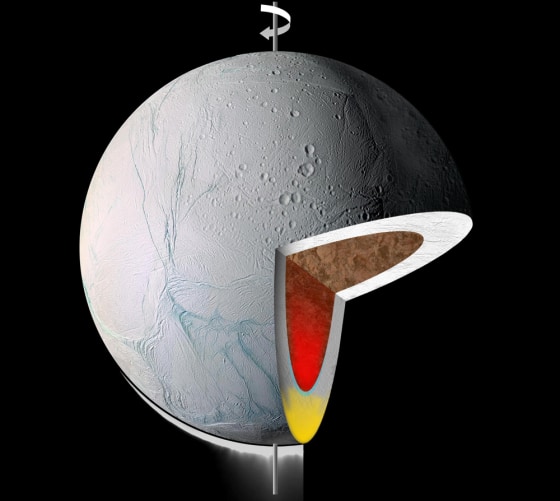
Saturn's moon Enceladus might have rolled over on its side sometime in the past, a suggestion that would account for a strange finding made by the Cassini spacecraft.
The moon has a hot spot at its south pole, an area of low density where water vapor shoots into space, Cassini discovered. Heat from within is likely created by the varying tugs of Saturn’s gravity as Enceladus' distance from the giant planet changes during the course of its orbit.
But why is there a hot spot only at the south pole?
"When we saw the Cassini results, we were surprised that this hot spot was located at the pole," said Francis Nimmo of the University of California at Santa Cruz. "So we set out to explain how it could end up at the pole if it didn't start there."
Remember Weebles? "They wobble but they don't fall down"? A similar imbalance seems to have caused Enceladus' cosmic flop, but with a twist.
in Thursday's issue of the journal Nature, Nimmo and colleagues explain that hot material from within Enceladus welled up in one location. Hot material expands and is less dense.
Like all rotating bodies, the moon would be more stable if low-density areas were at the poles and regions of high density were at the equator. So the moon reoriented itself in that manner, the thinking goes.
There is a way to possibly confirm that the moon flipped. Its former leading hemisphere should have had more impact craters than the trailing hemisphere. If it flipped 90 degrees, the pattern of craters now present would reveal as much.