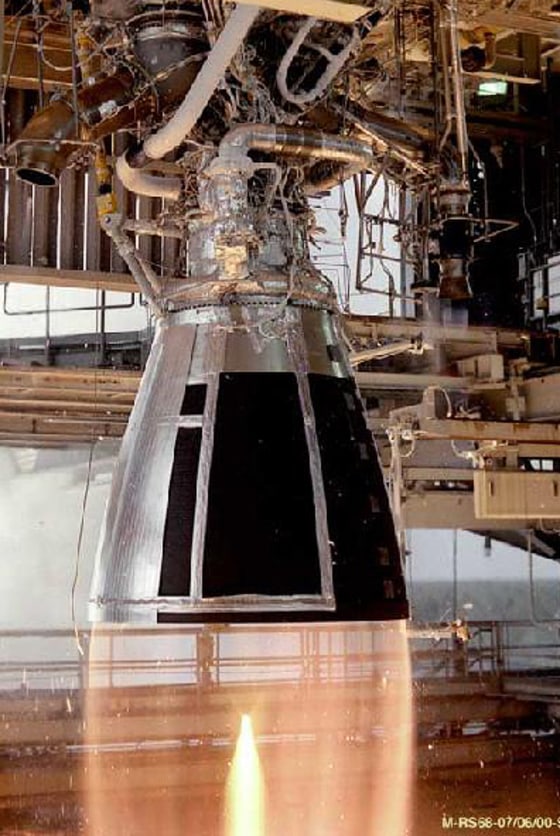
NASA is dumping plans for a throwaway version of the space shuttle’s main engines for its planned cargo launcher and will instead buy existing rocket engines used on the Boeing Co.’s Delta 4 boosters, space agency officials confirmed Tuesday.
Both the shuttle’s main engines and the RS-68 motors that power Boeing’s Delta rockets are made by Pratt & Whitney Rocketdyne, a unit of United Technologies Corp. that is based in Canoga Park, Calif. Reports about the plan to go with the RS-68 engines first came to light last month. (PDF file).
NASA estimates the cost of buying the Delta motors for its heavy-lift cargo launcher will be about $20 million per engine — half the price of a revamped shuttle main engine. The price is based on a flight rate of two launches per year.
NASA is developing two new vehicles to replace the space shuttle, which is scheduled to be retired in 2010. One vehicle will carry astronauts aboard an Apollo-style capsule, and the other will be used to loft cargo needed for expeditions to the moon.
Upon completion of the half-built international space station, the United States plans to refocus its human space program on lunar expeditions.
The crew launch vehicle will use the same solid-fuel boosters that propel the shuttle during the first two and a half minutes of flight.
The cargo hauler will use shuttle solid-fuel boosters as well, in addition to five liquid-burning RS-68 engines. The solid-fuel boosters are made by Minnesota-based Alliant Techsystems Inc., which produces the motors in Utah.
Still to be determined is a contractor to build an upper-stage engine for both vehicles, which will be based on an Apollo-era J-2 motor.