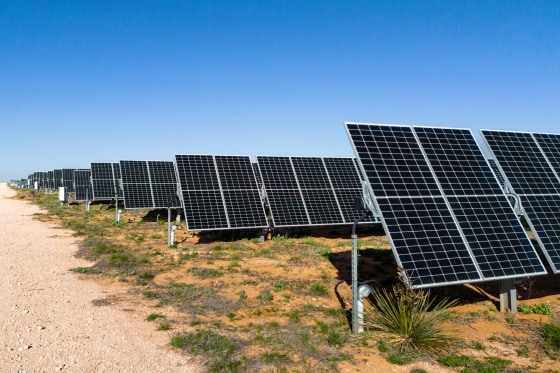
Private renewable energy projects are still moving forward despite a pullback in government support, and new technology is making that construction more efficient.
Solar farms, for example, take meticulous planning and surveying, involve long hours and require significant labor. Now, robots are taking on the job.
CivDot is a four-wheeled robot that can mark up to 3,000 layout points per day and is accurate within 8 millimeters. The machine can ride over rugged terrain and work through rough weather.
It is the brainchild of California-based Civ Robotics.
“Our secret sauce and our core technology is actually in the navigation and the geospatial -- being able to literally mark coordinates within less than a quarter inch, which is very, very difficult in an uneven terrain, outdoor surfaces, and out in the desert,” said Tom Yeshurun, CEO of Civ Robotics.
The data for manual surveying is uploaded into the Civ software, then the operator chooses the area they want to mark and presses go. The robot does the rest, saving both time and money.
“The manual surveying equipment, if you use that in the field and you have three crews, they will need three land surveying handheld receivers. That alone is already equal to how much we lease our machines in the field, and all the labor savings is just another benefit,” Yeshurun said.
Civ Robotics has more than 100 of these robots in the field that are primarily being used by renewable energy companies, but they are also used in oil and gas. It is currently working with Bechtel Corporation on several solar projects.
“These were usually pretty highly paid field engineers that we would send out there, and they might be able to do 250 or 350 pile marks a day. With the CivDot robot, we’re able to do about 1250 a day,” said Kelley Brown, vice president at Bechtel.
Brown said the company has used the robot in thick and muddy terrain in Texas and out in the deserts of Nevada.
“And so you have to think about things like the tires, or you may have to think about clearance. Are you trying to get over existing brush and such, across the solar field? So that’s one thing that we contemplate. I think the other is, you know, this runs on batteries, so you’ve got to contemplate battery swaps,” she added.
Civ Robotics is backed by Alleycorp, FF Venture Capital, Bobcat Company, Newfund Capital, Trimble Ventures, and Converge. Total VC funding to date is $12.5 million.
There are other robotics solutions for markings, but the competition is mostly doing work on highways and soccer fields. Yeshurun said those rivals can’t handle the terrains that the solar industry faces as it expands into new territories.
CNBC producer Lisa Rizzolo contributed to this piece.
