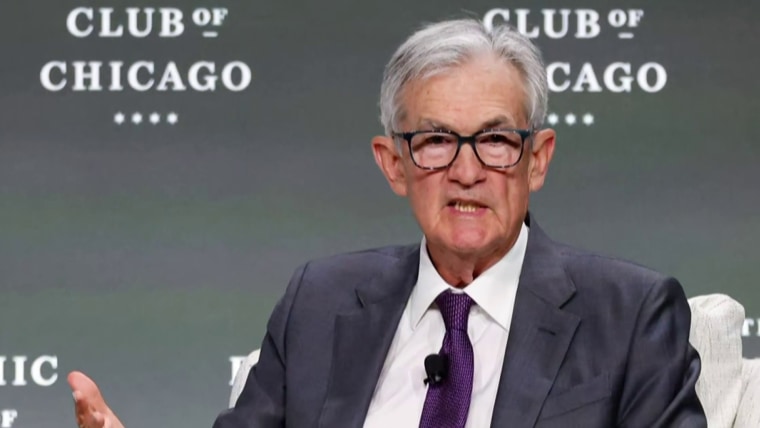
The Federal Reserve kept interest rates steady Wednesday at what is likely to be Chair Jerome Powell’s last policy meeting as the leader of the world’s most influential central bank.
Four Fed officials voted against the decision — the most since October 1992. Three of the four supported the decision to hold rates but “did not support inclusion of an easing bias in the statement at this time.” Stephen Miran, whom President Donald Trump nominated to the Fed, was the sole official favoring a quarter-point cut.
A statement from the Fed noted that job gains have “remained low” while inflation is “elevated,” in part from the “recent increase in global energy prices.”
“Developments in the Middle East are contributing to a high level of uncertainty about the economic outlook,” the Fed added.
Hours before the Fed’s announcement, the Senate Banking Committee advanced Trump’s nominee to succeed Powell, Kevin Warsh. The vote, divided along party lines, was the last hurdle Warsh needed to clear before a full Senate vote.
While Powell will leave the Fed chair role when his term ends May 15, he said he would remain as a governor on the Fed’s board until a Justice Department probe of him and the central bank is "well and truly over."
On Friday, the Justice Department said it would close a criminal investigation into Powell and the central bank. But Jeanine Pirro, the U.S. attorney for Washington, D.C., concluded her announcement with a warning, saying, “I will not hesitate to restart a criminal investigation should the facts warrant doing so.”
Adding to questions about the true state of the investigation, White House press secretary Karoline Leavitt said Friday, “The case is not necessarily dropped.” On Saturday, Trump remarked to reporters, “You know, it’s not dropped.”
Fed leaders serve simultaneously as chair and as a governor on its board, and Powell’s term as governor expires in January 2028. It would be the first time a chair has stayed on as a governor for any length of time since Marriner Eccles, who was Fed chair from 1934 to 1948.
Economic fallout
The Fed's rate-setting committee met at a moment when the U.S. economy is mired in uncertainty and facing headwinds on multiple fronts amid the war the U.S. and Israel launched against Iran.
This year, the price of U.S. crude oil has surged almost 70% as a result of the war. Airlines have cut thousands of flights worldwide as the price of jet fuel spikes. In March, inflation overall jumped 0.9% from February, to an annual rate of more than 3.3%.
Asked how the Fed is looking at price surges as a result of the war, Powell cautioned that "it hasn't even peaked yet."
"I think we'd want to see the backside of that and progress on tariffs before we even thought about reducing rates," he said.
Some economists and analysts have also wondered whether the Fed would go so far as to consider a rate hike when energy prices are soaring.
"If we need to hike, we will, we will certainly signal that," he said. Powell added that the committee felt it was in a good place to "move in either direction."
On a positive note for consumers, Powell said Fed officials expected tariff-related inflation to fall "in the next two quarters."
The steadiness of the labor market also remains a major unsettled question for Fed policymakers.
Powell said it wasn't an inflationary worry to him, though. "We don't feel that the labor market is at all a source of inflation," he said.
Economists at BBVA said Monday, “Labor market signals remain mixed and volatile, pointing to broadly stable yet still fragile conditions.” In January, the U.S. economy added 160,000 jobs, but it then shed 133,000 roles in February, before it appeared to rebound with the addition of 178,000 roles in March.
"There's so much uncertainty about the path ahead," Powell said.