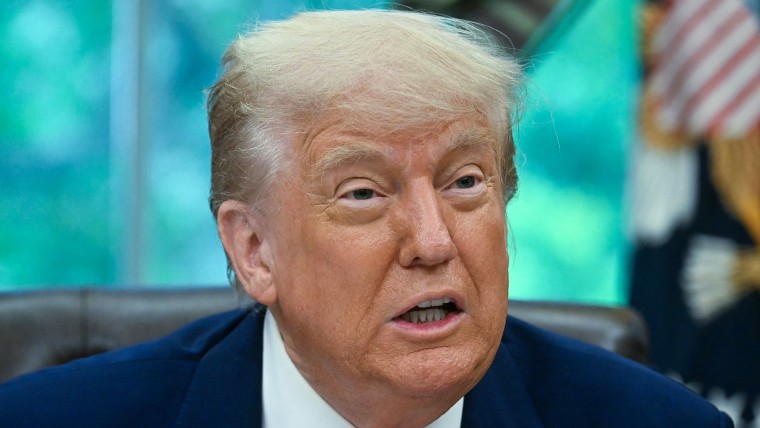
President Donald Trump has signaled a willingness to drastically cut the U.S.' current 145% tariff rate on China ahead of trade talks between the two countries.
Trump wrote in a Truth Social post Friday morning: "80% Tariff on China seems right! Up to Scott B.," appearing to refer to Treasury Secretary Scott Bessent.
The post comes a day before Bessent and U.S. Trade Rep. Jamieson Greer meet with their Chinese counterparts in Geneva for trade discussions.
Trump indicated Thursday that he might be open to lowering the current 145% tariff on China. “ I mean, we’re going to see. Right now, you can’t get any higher,” he said during remarks from the Oval Office.
A representative for the Chinese embassy in the U.S. did not immediately respond to a request for comment.
An 80% across-the-board tariff would still be far beyond the duties the U.S. had in place on China before Trump took office. He first imposed a 20% levy on America's third-largest source of imports in response to its alleged inaction on curbing fentanyl flows, then signed an executive order several weeks later imposing 125% duties.
In general, Trump's unwieldy approach to tariffs negotiations has continued unabated: On Thursday, he announced an agreement was being worked out with the U.K. that contained few details but which would leave the U.S.'s 10% across-the-board duty on all countries mostly intact. Yet while the agreement signaled pathways to expand U.S. exports of beef, ethanol and other agricultural products, it provided no guarantees, as yet, that the U.K. would actually increase imports of those products.
Trump has attempted to walk back the eye-watering country-by-country duties he announced during his shock "Liberation Day" speech more than a month ago.
But sizable levies remain, including 25% duties on all steel, aluminum and auto imports. While discussion of trade deals remains plentiful, actual progress on them has been relatively scarce — leaving business confidence throttled.
A number of companies have already changed their forward guidance or reversed it entirely as a result of the uncertainty.
It's also not clear that the China tariffs are having Trump's desired effect. In April, according to CNBC calculations, China’s exports surged amid a ramp up in shipments to Southeast Asian countries — an indicator that China may simply be increasing trans-shipment of goods to third-party countries that then export to the U.S., an expert told CNBC.